Author: campfirechants

Song 12: Body of the Earth

Listen to the album free on YouTube and Spotify

© 2016 by Starhawk

Em                                                 D Em

We are of the body of the Earth

Em                                                           D Em

The Earth is of the body of the stars

Em                                                        D                         Em

We are stars that circle from life to death to birth (2x)

Descant

We are Earth

Earth is star

We are stars

Life death birth

(Alternate final line: Like a diamond)

History & Lore

Starhawk:

I wrote this for the Pagan Book of Living and Dying (around 1994). I felt we needed some songs about death and rebirth.

I’ve often used it at Winter Solstice rituals. Something about the Winter Solstice and the night and stars.

We used to do Winter Solstice up at Sebastopol Community Center, and they have a disco ball. It’s really nice to be singing about the circling stars with the disco ball – it’s quite trancey!

When I was writing this song, I was thinking about physics. The Earth literally is made of stardust, and so are we.

George:

It turns out there is another verse to this song, which magically migrated to Weave and Spin – see the History & Lore section of Song 6.

I learned this song from Sage Goode and Amy MoonDragon at California Witchcamp around 1998. We sang it over and over during a trance about caring for our bodies and recognizing them as divine.

Ever since, “calling down star energy” has been my favorite purification.

The song has been sung at various Bay Area rituals, and is a staple of Earth night during Reclaiming’s Elements of Magic classes.

Body of the Earth was the spiral song for the opening ritual at the 2016 Witchy Disco (a fundraiser for the Mysteries of Samhain retreat).

Musical note – the “Strand by Strand” descant of Weave and Spin also works with this song.

Listen to the album free on YouTube and Spotify
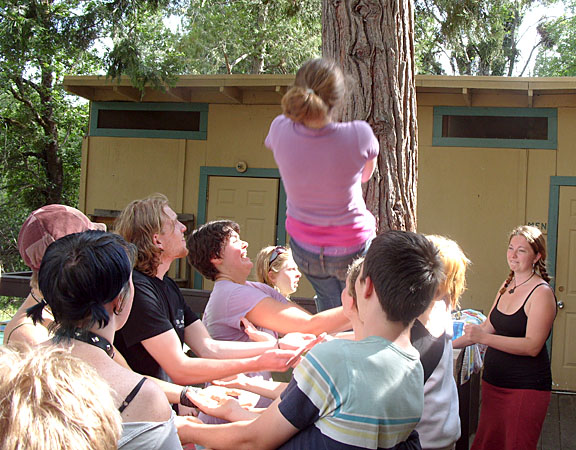
tem09-Trust-M2488

Photo: Trust-falling into the arms of one’s peers – embodying the change. Photo from Teen Earth Magic, courtesy of Reclaiming Quarterly archives.
Return to Home Page

Earth Activist Training

Listen to a playlist of Starhawk’s Earth-positive chants on Spotify or YouTube

EAT is permaculture, Earth-based spirituality, organizing and activism with Starhawk and a team of stellar teachers and designers

Chants16-Pic-RanchPlanters2093

Listen to a playlist of Starhawk’s Earth-positive chants on Spotify or YouTube!

Planting the Seeds of Change

With Starhawk and Earth Activists

Earth Activist Training (EAT) can set your life on a new path… or show you how to save the world.

Green solutions are sprouting up around us. Permaculture shows us how to weave them together into systems that can meet human needs and regenerate the natural world.

EAT, begun in 2000 by Starhawk and Penny Livingston-Stark, is practical Earth-healing with a magical base of ritual and nature awareness, integrating mind and heart, with lots of hands-on practice and plenty of time to laugh.

Permaculture has many tools to address the problems of climate change and environmental degradation, and our courses focus on solutions and positive approaches to the grave problems which confront us today.

We believe learning should be interactive, participatory and experiential, so our courses include many hands-on projects, games, songs, exercises, discussions, and rituals as well as classroom time.

EAT has a special interest in what is now being called Social Permaculture – the application of ecological principles to designing beneficial human relations.

EAT teachers are deeply involved in organizing around climate change, anti-racism, and social justice as well as environmental issues. We work with the Black Permaculture Network, and co-wrote the solidarity statement that is on their website.

We were instrumental in organizing the Permaculture Climate Change Solutions group with an international scope. EAT grads have worked in Brazil, Africa, Palestine, Israel, Mexico, Jamaica, India, Thailand, Spain, France, England, Australia, and all over the U.S. and Canada.

We have a commitment to share these skills and tools with the communities most impacted by injustice.

Permaculture Design Certification

Our two-week intensives are Permaculture Design Certificate (PDC) courses, offering the basic, internationally-recognized 72-hour permaculture curriculum with an additional focus on social permaculture, organizing tools, and spirit.

We also offer training in Social Permaculture and Facilitation, mentoring for teachers and designers, and consult with community groups.

EAT intensives are offered several times each year, in varied bioregions. For dates and info, visit our website.

EAT’s Mission Statement

To bring the knowledge and resources of regenerative ecological design to communities with the greatest needs and fewest resources.

To teach visionary and practical solutions and personal sustainability to social change activists, and to teach practical skills, organizing, and activism to visionaries.

To cross-pollinate the political, environmental, and spiritual movements that seek peace, justice, and resilience.

Listen to a playlist of Starhawk’s Earth-positive chants on Spotify or YouTube!

Contacts

Web: EarthActivistTraining.org

Web: Starhawk.org

Email: earthactivisttraining@gmail.com

Phone: (800) 381-7940

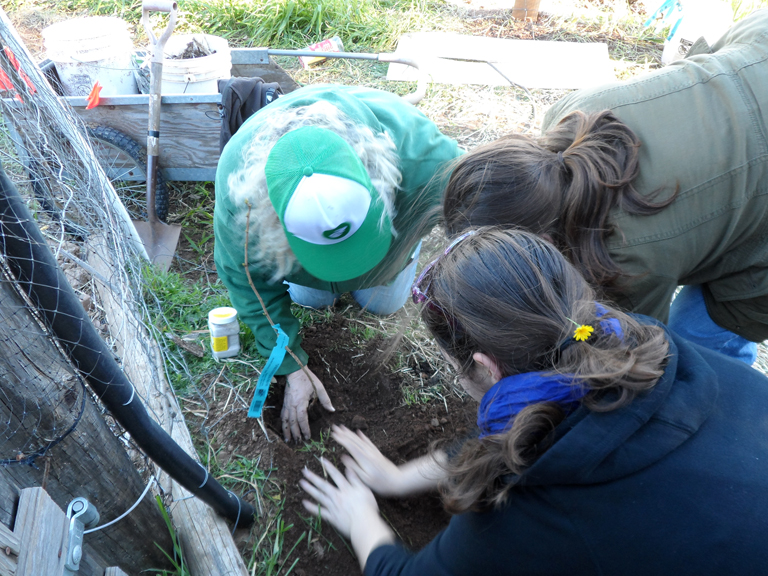
Photo: Planting seedlings with intention, magic, and micorrhizal fungi.  Teen EAT mini-intensive, 2015. Photo by Luke Hauser/DirectAction.org

Return to Home Page

Song 13: Let the Beauty We Love

Listen to the album free on YouTube and Spotify

Melody & arrangement © 2016 by Jeffrey Alphonsus Mooney

C

Let the beauty we love, be what we do

C                                                                  G                                 C

There are hundreds of ways to kneel and kiss the ground

Lyric adapted from a poem by Jalāl ad-Dīn Muhammad Rūmī and translated by Coleman Barks:

Today, like every other day, we wake up empty and frightened.

Don’t open the door to the study and begin reading. Take down a musical instrument.

Let the beauty we love be what we do. There are hundreds of ways to kneel and kiss the ground.

fire-candleNC113

History & Lore

Interview with Alphonsus by Reclaiming Quarterly.

RQ: Was Let the Beauty written for a specific ritual?

Alphonsus: I didn’t “write” the song. I found a way to take a poem and give it legs. I want to say it was at Missouri Witchcamp, maybe 15 years ago.

I’d been discovering Sufi ecstatic poetry. I look at these poems and there is an initial “aha!” But also a real challenge – it would kick your ass if you really understood this poem!

I was seeing that there was this long historical lineage. Here I was, reading some person’s words from the distant past, and I was like the new kid on the block. Reclaiming was a new spiritual path, we’re singing around the fire – and these words are so in alignment with the spirit we are trying to conjure.

RQ: You used the word “lineage.”

Alphonsus: There is a gravitas, a legitimacy. People from other parts of the world, from long ago, who were revered – and we’re saying what they’re saying. It wasn’t about trying to be Sufis. It’s about breathing into heart space, wishing the world well, not getting caught up in material means.

I was looking at these words and I thought, it speaks to such a beautiful mind-state, such a nice feeling-state. It’s so inclusive: “There are hundreds of ways to kneel and kiss the ground.”

It affirms everyone in such an inspiring way.

RQ: Where did the melody come from?

Alphonsus: I didn’t want to sing the whole poem, just that one line. I thought, what’s the feeling here? I hummed, and a tune came. It just fell out that way.

Sometimes I come up with a song, and a month later I think, I like these words, but there’s a different melody.

But with Let the Beauty, I remember it coming out really naturally. The muse came to me. And more people know the line because it’s sung.

RQ: What’s it like to “write” a chant that people love, yet they aren’t your words?

Alphonsus: It’s a funny thing about the folk tradition – ownership. You feel grateful that something has come through you. Other people are singing this song, its very affirming of your own creativity. It’s passed some test if other people also want to sing it.

I was at a witchcamp where someone started singing Let the Beauty We Love, and didn’t say who it was by.

And I thought: That’s my song that I didn’t write!

George:

At our late-night campfires at California Witchcamp around 2000, (in between songs and rounds of Truth or Dare), Alphonsus would drum and recite fragments of Rumi poems. The lyrics of this chant often formed the final words of a free-form Rumi improv.

This is a favorite chant at Reclaiming rituals and classes. Once we sang it at two San Francisco rituals in a row, because the first time, when we were at the beach, it didn’t sound so great. We wanted to get it right.

Photo by Naeomi Castellano/RQ.

Listen to the album free on YouTube and Spotify

Return to Home Page

Chant Writing: Interview with Jeffrey Alphonsus Mooney

Chants15-pol-PaganDrummers5159

Reclaiming Quarterly talked with chants author and witchcamp teacher extraordinaire Jeffrey Alphonsus Mooney about how he writes chants. The chant he discusses is I See, from our earlier album Witches Brew: Songs and Chants from the Reclaiming Cauldron (2006). See also his comments on Songs 6 and 13.

RQ: When do you write chants? For specific occasions, or do they just come to you whenever?

Alphonsus: Let me tell you a story. I was teaching at Vermont Witchcamp, and it was the mid-week ritual, which tends to be the deepest. We don’t want to start or end the week deep, but we can go deep here.

I was finding myself having a very hard time with some people on the teaching team – I was getting triggered. But we have to work together, and I’m supposed to come up with a chant for the ritual – and now it’s after dinner.

I’d been teaching a path all week about chants, writing, words of power – all that stuff.

RQ: Sounds like an air-type of path, personal expression.

Alphonsus: I ran to the spot where I was teaching the path, and I literally said, “Words, please come to me.”

My first parameter was – say things that are true. I started writing a few lines, and I noticed this other part of me had managed to find lines that rhymed.

I felt like I was on a roll. It was a new moon… Mars was in sight… A new moon, dark night…

“New moon night, soon Mars in sight” – now what?

“Deep silence finds us when the words aren’t right .” And I thought, this is going to be good!

The rest came out, uncorrected: “Free us from fear, may our hearts sing clear, Make a spark in the dark for our soul’s delight.”

RQ: What about the chorus?

Alphonsus: I needed a rallying point. We were doing shadow work on a dark night.

And privately I’m being triggered. I needed to do my own work.

I came up with “I see myself in you.” So in the ritual, we walked around the fire and looked into each others eyes, singing, “I see myself in you.”

For me to look into the eyes of the person that I was upset with and sing this, there was a divine chuckle! There was an instantaneous shift. It softened the edge.

That was an experience where the words all came as an inspiration. It was like, where did that come from? Which then makes it funny to say, “I wrote it.”

RQ: Well, you wrote it down.

Alphonsus: I know I had something to do with it!

RQ: What’s your goal when you write a chant?

Alphonsus: When I think of a good chant there’s a compressed energy that makes you want to say it over and over again. Short, repetitive language – it’s like spell-crafting.

Another place I think of compressed language like this is in the streets.

RQ: Right – that’s the other place we use chants.

Alphonsus: Some of the slogans get a bit tedious. Can we come up with something more clever that many people can join quickly? That’s the point – what helps many people sing together?

The word “conspire” literally means to breathe together.

We’re part of a history of collective joy, as Barbara Ehrenreich says. What do we bring to this history?

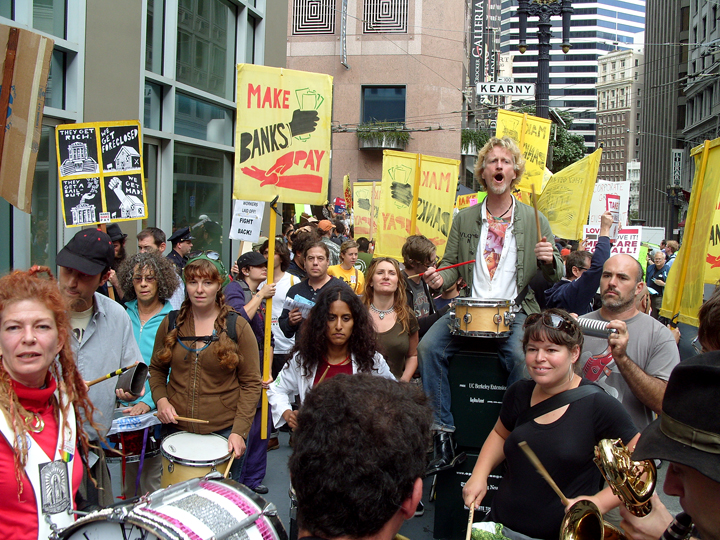
Photo: Drummer Jeffrey Alphonsus Mooney and other Pagan Cluster musicians chant in the streets of San Francisco – Make Banks Pay, 2011. Photo by Luke Hauser/RQ.

Return to Home Page

Song 14: Rising of the Moon

Listen to the album free on YouTube and Spotify

© 2016 by Starhawk

Dm                                                                                     C                        Dm

(We are the) Rising of the moon, we are the shifting of the ground, we are the

Dm                                                          C                                 Dm

Seed that takes root, when we bring the fortress down, we are the… 

Chants15-pol-SolsticeDA-MoonCone4467


History & Lore

Interview with Starhawk by Reclaiming Quarterly

RQ: I associate Rising of the Moon with the globalization actions of the 2000s.

Starhawk: This is a song we’ve used a lot in political actions, in the streets. It’s a nice one to teach to activists. People really like the sense of bringing the fortress down – stamping down as they sing.

RQ: Did you write it for a specific action?

Starhawk: Yeah, in 2002, the G8 met in Calgary. We had a Pagan Cluster that went there to organize. We had a full moon ritual right before the action at a Unitarian church which had a labyrinth, and I felt like we needed a new chant. I was walking the labyrinth and preparing for the ritual, and came up with that.

We got to doing a lot of magic around the organizing. At first it seemed like the action would be really scary. These “terrible anarchists” were coming to town, and there was this big militarization around it. We did some magic where we set a magical drain for fear in downtown Calgary, and it seemed like things turned around. Suddenly the cops were all in bicycle shorts –

RQ: It’s always a good sign when the cops are in bicycle shorts!

Starhawk: So there was a big march, and nobody got arrested. It was a very successful first day of actions.

Then we had a second day. Like most mobilizations, we’d spent months planning the first day of actions, but no one had planned the second day. So we did a group trance about it.

RQ: Thank goodness for magic.

Starhawk: Somehow in the middle of the trance I was reminded of this vision that I’d had the one and only time I ever took ayahuasca. I had been invited to this ecumenical conference in Brazil. Everyone was doing their different rituals, and I was invited to a Santo Daime ceremony.

You’re supposed to go in with a question. The question I went in with was, “Do we have enough time to make all the changes we need to make?”

I had been asking religious leaders (at the conference), and getting various answers.

I asked the ayahuasca, and it said “No! But you’re a witch — you can work outside of time. Part the curtains of time, and plant the changes in that timeless place where they’ve already taken place.”

Then I had a vision of this huge fortress, overpowering, soldiers and clone-like robocops coming and coming. But when I looked, it was all cracked and brittle. And I heard “the fortress falls, and the ground beneath it shifts.”

RQ: So you brought this vision to the Calgary protests?

Starhawk: Yes. At the G8 protests in Calgary we worked with this image of the fortress, with vines and leaves pushing through the cracks and breaking it apart.

RQ: Which is the theme of the song. What was the actual protest you did?

Starhawk: We got this idea that on the second day of actions we would do Mud People, which is something a bunch of crazy artists and dancers were doing in SF. They’d go down to the financial district, strip off almost all their clothes, and cover themselves with mud. Once covered with mud, the rule was, you couldn’t walk normally or talk. So they’d be grunting and writhing through the financial district at lunchtime as an art piece.

RQ: I remember being part of a mud people action at California Witchcamp around 2000.

Starhawk: Right, Beverly brought this to witchcamp. So periodically, when we were having some deep consensus meeting, mud people would erupt and start crawling around stark naked.

We had this idea to do it in Calgary. Well, Calgary is like the Texas of Canada. All the oil companies are there, it’s the most conservative place in Canada.

We had 60 crazy people who stripped off their clothes and dove into the mud. A few of us were like, I don’t think I’m going to get naked and writhe through the streets of Calgary. I think some of us need to be able to talk.

So we started to write a flyer, and I suddenly said, this doesn’t call for a flyer – this needs a prophecy!

*          *          *          *

George:

I was in a spiral dance with Pagan Cluster people just back from the Calgary action. Every time we got to “bring the fortress down” they’d cast their hands downward – which in a spiral dance is rather jarring!

As we were recording Campfire Chants, I was part of a late-night song circle at 2016 Jewitch Camp. I started by sharing  We Are the Rising Sun (Song 3 on this album).

Someone who had no knowledge of our not-yet-released album said, “That’s a beautiful song about the vision we’re struggling for. But life isn’t all about beauty. Sometimes we’re really angry. I want to share a song about those moments.”

And she launched into Rising of the Moon.

Listen to the album free on YouTube and Spotify

climate15-marchfront-lakeside2588

Photos

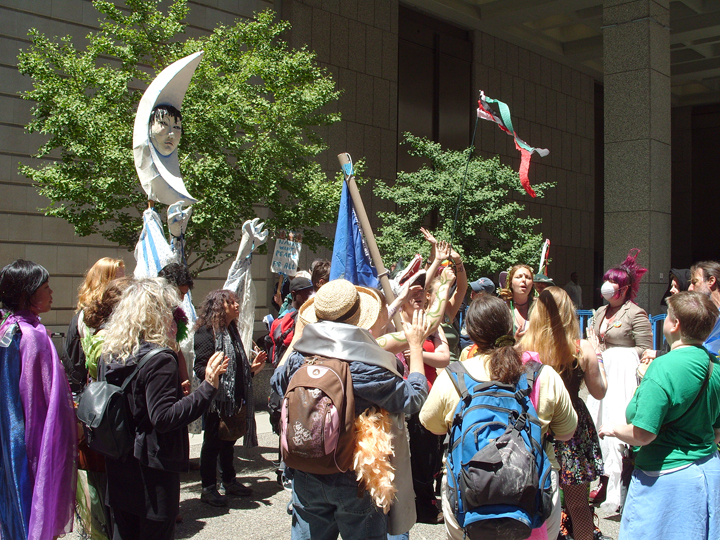
Top: Solstice in the Streets, San Francisco 2011 – the moon rises over a cone of power outside energy profiteer PG&E. Photo by George Franklin/RQ Archives

Bottom: Pagan Cluster folks join a march for Climate Justice in Oakland, 2015. Photo by Luke Hauser/DirectAction.org

Return to Home Page

Song 15: Cycles of the Moon

Listen to the album free on YouTube and Spotify

© 2016 by George Franklin

Am                       Em

Cycles of the moon, the stars, the Earth

Am                          Em

Secrets of the path, from death, to birth

Am                        Em

Keeper of the flame, the source, the light

Am                            Em

Presence of the deep, the dark, the night

Em                           Am                                Em

Stay with me a while, Spirits of the Nile

***

History & Lore

George:

The music for this song, originally called Spirits of the Nile, was inspired by Bob Marley’s song Exodus. The lyrics were inspired by a long-ago crush.

In about 1992, a friend and I were recording a pirate radio show in a garage studio in the SF Mission District. She did a segment about preserving the Berkeley wetlands – my role was making quacking sounds in the background.

By the time we finished, we’d missed the last train back to the East Bay. We spent the night at the studio and wound up going out into the postage-stamp back yard and doing a long ritual, during which she invoked Egyptian deities I dimly recognized.

A week later I was fiddling around with the guitar figure and started singing “Daughter of the Nile.” Pretty soon a whole long song about life and death and rebirth unfurled itself – not topics I typically wrote in those days, when I was playing in the political band Funky Nixons.

The chant here is the chorus of that song, with the lyric changed from Daughter of the Nile to Spirits of the Nile for musical and cultural reasons.

The Music

The chant is in 7/4. This was an accident, following the natural rhythm of the words. I only discovered the odd meter when I tried to put a drum machine under it.

For this recording, Paul did several takes on conga until he found a beat that kept the choppy 7/4 rhythm moving steadily forward.

The guitar part is basically in Em. The snaky guitar figure is an Am chord with the first finger lifting on and off to play the melodic lines, then resolving to Em on the down-beat as shown above.

Dress’s clarinet solo in the middle 4/4 section was done on a single take. The two of us have played the song around Witchcamp and Witchlets campfires for many years, and he knew the spooky feel it needed.

(Dress and I became friends in jail at Livermore Weapons Lab way back in the 1980s, notably when he wore a white formal wedding gown for the June 1983 protest – a sartorial choice which led directly to his current nom de guerre. The action is described in Luke Hauser’s book Direct Action: An Historical Novel – see sidebar to song 9).

Original Verses

Original verses to Spirits of the Nile, written 1992 and © 2016 by George Franklin

Cast your sail, ‘cross the River Nile,

Cross the desert sands, out past the pyramids

Search for signs of the older days

And feel the rhythm of the ancient ways

What did they know that we don’t know?

They knew something that we don’t know,

We don’t know, we don’t know…

Cycles of the moon, the stars, the Earth

Secrets of the path, from death, to birth

Keeper of the flame, the source, the light

Presence of the deep, the dark, the night

Stay with me a while, Spirits of the Nile

Verse 2 

If I knew, if I knew the words,

Knew the magic signs, I knew the formulas

Call you back from the distant shore

Sweet incantations ringing evermore

Bring us truth from the other side

Bring us the truth from the other side

Other side, other side

Cycles of the moon, the stars, the Earth

Secrets of the path, from death, to birth

Keeper of the flame, the source, the light

Presence of the deep, the dark, the night

Stay with me a while, Spirits of the Nile

Listen to the album free on YouTube and Spotify

Return to Home Page

Song 16: One with the Darkness

Listen to the album free on YouTube and Spotify

© 2016 by Meg Yardley

The chorus of this song is from a poem by Wendell Berry.

Song is recorded in C. Capoing 3 frets and playing in key of A makes some parts easier (we recorded guitar in both keys and did mix-and-match editing). Here are both versions.

Chorus

C (A)                                                        F (D) C (A)

At night make me one with the darkness

C (A)                                            G (E)                C (A)

In the morning make me one with the light

C (A)                                                         Am (F#m) – C (A)

At night make me one with the dark     –     ness

C (A)                                           G (E)                 C (A)

In the morning make me one with the light


Night Verse 1

Cm (Am)                           G (E)

The night is time for dreaming

C (A)                                   Am (F#m)

of what may come to be

Cm (Am)                           G (E)

The night is time for drifting

Cm (Am)                       D7 (B7) – G7 (E7)

through possibili – ty

– CHORUS –

Morning Verse 1

F (D)                                         C (A)

The morning is time for opening

F (D)                                              C (A)

our minds, our hearts, our eyes

F (D)                                         C (A)

The morning is time for shining

Dm7 (Bm7)                 G7 (E7)

as like the sun we rise

– CHORUS –

Night Verse 2

The night is time for letting go

of burdens that we bear

The night is time for trusting

for comfort and repair

– CHORUS –

Morning Verse 2

The morning is time for stepping out

onto the path that’s true

The morning is time for changing

for building the world anew

– CHORUS –

History & Lore

Meg:

I wrote this song around the time of the Winter Solstice. My daughter was a toddler and I wanted a lullaby to sing to her about the blessings of darkness as well as the blessings of light.

The words of the chorus, from a poem by Wendell Berry, were in an illustrated child’s book of blessings I used to read with her.

One day as I was running around doing errands to get ready for our winter holiday travels, I started putting the words to music.

I wanted to use both minor and major keys to represent the balance between darkness and light, the sweet and the bitter. I started to write a verse about nightmares and fears that can arise in the night – I wanted to be real about the fact that night isn’t always easy and restful.

But I thought that we humans already give these aspects of night plenty of attention. I wanted to bring more awareness to the blessings and benefits.

(And of course I didn’t want to write a lullaby that would scare my kids into staying awake!)

Listen to the album free on YouTube and Spotify

Return to Home Page

Song 17: Skit: Around the Campfire

RQ#102-Fire-Megan1

Listen to the album free on YouTube and Spotify

Our honored guests chime in

Part of the magic around the late-night campfire is never knowing who might still be awake and stop by.

It might be a beloved friend or teacher. It could be an emissary from the kitchen with some leftover snacks.

Or it might be the spirit of an ancestor. They’re with us all the time.

Some come to sing, some to hum along. Some love it when we sing their songs. Others get cranky because we change the words.

Some savor the smell of smores. Others flee at the first lines of Puff the Magic Dragon.

You never know what dear comrade or cantankerous predecessor might contribute to the proceedings.

Our Honored Guests

To round out this recording we invited a variety of special guests to lend their voices around the campfire. You’ll hear them following several songs.

Witchcamp friends Starhawk and Magic Brook discuss music and ritual. Chorus members warm up while kids play in the background. Fiddle and flute diligently tune up.

Careful listeners might also hear ancestral voices of (or readings from) the Gnostic text Thunder, Albert Einstein, Virginia Woolf, John Lennon, Baruch Spinoza, patrons at the Café Americain, the gospel of Luke, Groucho Marx, Jane Austen, Leon Trotsky, Charles Mingus – and that’s Janis Joplin’s witchy cackle following Wheel of the Year.

Welcome all!

Listen to the album free on YouTube and Spotify

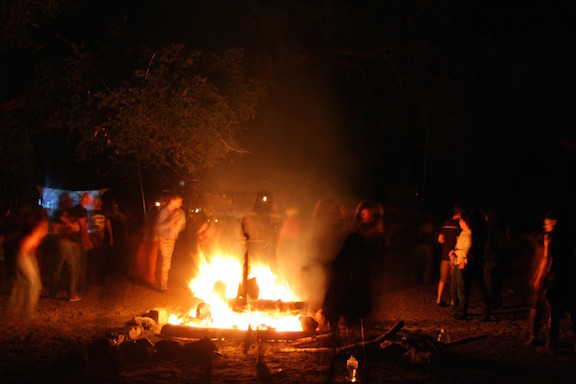
Photo courtesy of Trillium/RQ.

Return to Home Page

Song 18: Goodnight Sweet Witches

Listen to the album free on YouTube and Spotify

Traditional – arrangement © 2016 by George Franklin

C                                                                                                      F                        C

Goodnight sweet Witches / Redwoods / Witchlets, lay down and rest

C                                                                   D                          G

Lay down your weary heads, and be the forest’s guest

C                                                                 F                           C

The stars will guide you, your dreams’ll do the rest, we bid you good-

F                              G                     C

Night, good-night, good-night

*                      *                      *

RQ#102-Fire-Megan1

History & Lore

George:

Goodnight Sweet Witches came to us straight out of Western Appalachia. A late-1990s California Witchcamper visiting from Kentucky sang this song with great enthusiasm, and it’s been a staple of our campfires ever since.

After I’d sung this upbeat-lullabye version for a while, someone told me that the Grateful Dead used to end concerts with a quiet acapella variant of the song, which can be found on youtube as “And We Bid You Goodnight.”

Their melody and lyrics are rather different, but both versions include “lay down and rest,” and both end with “and we bid you goodnight.” The Dead’s version gave us the idea for the slow-down ending recorded here.

When a kid leaves the campfire for bed, we try to stop what we’re doing and sing this song, beginning with their name: Goodnight, sweet so-and-so….

Truthfully, the tired kids seldom seem very impressed by the effort. But it’s fun to sing it to them just the same.

About Those Redwoods:

Verse 2, Goodnight Sweet Redwoods, is sung for Redwood Magic Family Camp, which organized this album. If we were going to sing a verse for Witchlets, we pretty well had to sing to the Redwood Magic folks too!

But it’s nice to think of singing a lullabye to the redwood trees that encircle us, too – even though they sleep standing up.

*                      *                      *

A wise elder once said: When you talk with redwoods, you have to wait a while for an answer – your words have to travel to the top of the tree, and its answer has to travel all the way back down.

*                      *                      *

Circled close round the witchcamp fire, we gaze into the coals as the last flames flicker.

Our campfires are made from fallen branches. Someone quotes Buckminster Fuller:

“Fire is the sun unwinding from the trees.”

The flames turn to embers.

And we bid you goodnight… goodnight… goodnight.

Listen to the album free on YouTube and Spotify

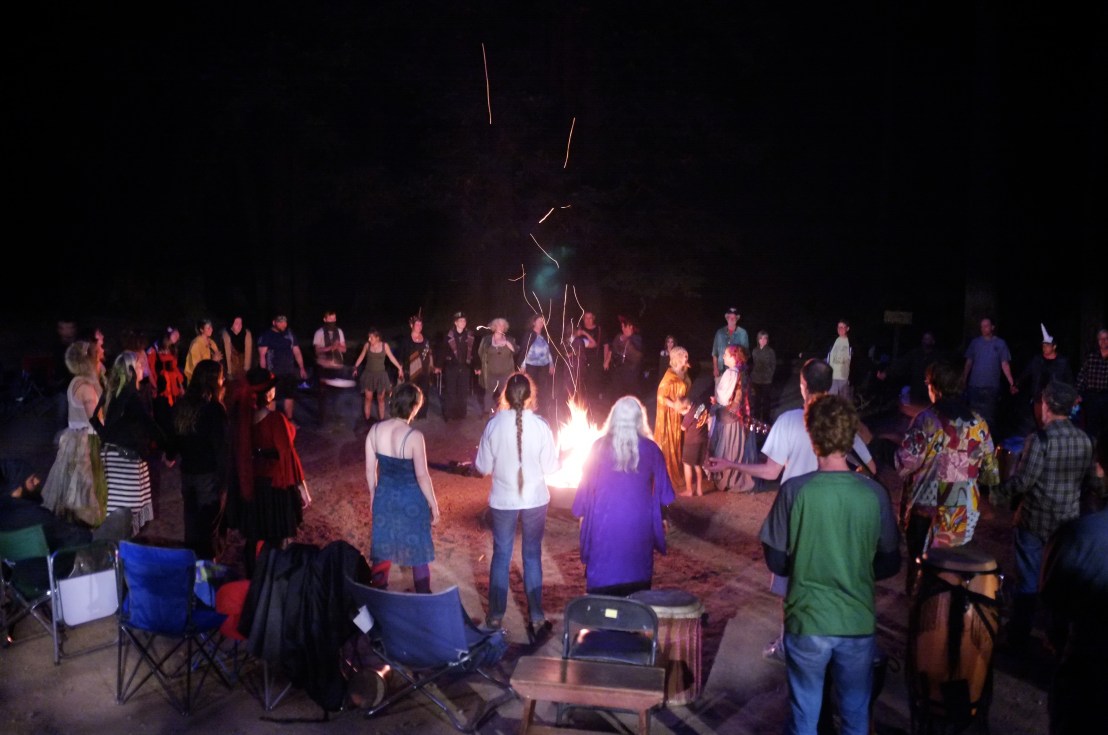
Photo courtesy of Trillium / RQ Archives

Return to Home Page